How to write a cursive Q
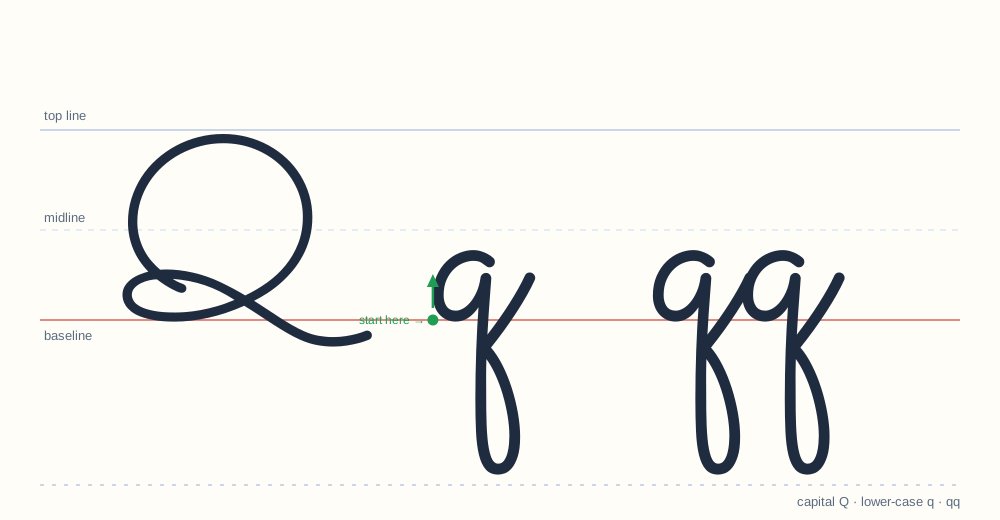
Circle counterclockwise like a, then a straight downstroke that goes below the baseline and kicks right.
Lower-case q, stroke by stroke
Same as the capital: circle, then a descender with a small right kick.
Joining Q to what follows
q joins from the descender kick. 'qu' is its most common pairing.
Common mistakes with Q
Forgetting the descender (looks like a), or connecting from the circle instead of the tail.
How Q relates to its neighbours
Letters are learned in families, and Q belongs to a family too: the descender family, with g, j, y and q. Practising it next to a family member exposes the difference in a way that practising it alone never does. Write the pair on the same line — Q then its neighbour — and check which stroke changes. That single comparison teaches more than a page of isolated repetition.
Judging progress honestly
The question is not "does it look perfect" but "is it stable". Write Q ten times without the model in sight; if the ten look like the same letter, the pattern is set, even if it is not beautiful. Beauty comes later, from speed and confidence. If the ten drift into different shapes, the model needs to stay visible for another week — that is not failure, it is the normal order of learning.
A short practice routine for Q
Ten minutes, once a day, beats an hour on Sunday. A workable routine: two minutes tracing the model letter, three minutes writing it on blank lines, three minutes on the words below, two minutes comparing your last line with your first. The comparison step is the one people skip, and it is the one that makes the practice stick — the eye learns the shape as much as the hand does.
Practice it in words
quick quiet question quite square
The one-page Q worksheet puts these words under the trace lines, so the letter gets practiced in context rather than alone.
What a correct Q looks like
- Height: dips below the baseline, like g and y.
- Start and exit: begins at the baseline, ends ready to join the next letter.
- Proportion: the loops and curves stay even across a line — uneven Qs are the first sign of rushed practice.
Download the Q worksheet (PDF) All 26 letters
New to cursive? Start with the beginner guide.