How to write a cursive X
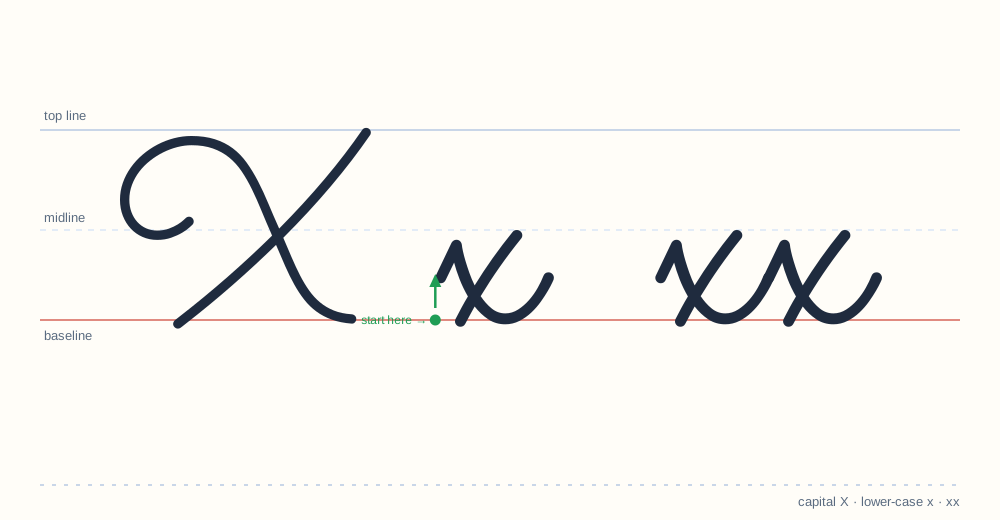
The x is two crossing strokes, the second finishing with an exit. Its crossing point sits at the midline, not below — a low crossing makes it look like a multiplication sign.
Drawing the capital
Start at the midline, diagonal down to the baseline, then a second diagonal back up, ending with an exit.
Drawing the lower case
A small cross from the midline to the baseline, then a second stroke crosses it.
The join after X
x joins from its second stroke. The x is rarely doubled.
Where it goes wrong
The two strokes crossing too high or too low, or no exit stroke.
Setting up practice for X
Three things decide whether practice works: the surface, the tools and the length. A flat table, a pencil with a visible point and lined paper with a midline — that is the whole setup. Sessions of ten minutes beat sessions of thirty; a child who practices tired learns a tired version of the letter, and unlearning it costs more than the extra minutes gained. For the X specifically, print two copies of the worksheet: one for the first attempt, one for the comparison at the end of the week.
The adult version of X
Adult cursive drifts away from the school model: the curve gets faster and the letter flattens. That is normal — handwriting is a tool, not a museum piece. But when an adult wants to improve legibility, the fix is always the same: go back to the school letterform for a week, then let speed return on its own. The letter below the drift is still the letter; X does not change its identity at speed.
Where X sits in the three zones
Cursive measures every letter against three horizontal lines: the top line, the midline and the baseline. X occupies the middle zone only. Keeping that height consistent is what makes a page of handwriting look even — a letter that drifts up or down is the first thing a teacher notices, before any question of style.
Words to practice
box six next fix text
These words appear on the printable X worksheet (PDF, 1 page), which also carries trace models for both cases and blank practice lines.
What a correct X looks like
- Height: stays inside the middle zone, like o and n.
- Start and exit: begins at the baseline, ends ready to join the next letter.
- Proportion: the loops and curves stay even across a line — uneven Xs are the first sign of rushed practice.
Download the X worksheet (PDF) All 26 letters
New to cursive? Start with the beginner guide.